
Game Evolution
Ideas shaping the gameGame Evolution

By Justin Waggle Designer of Wu Wei: Journey of the Changing Path
Second Edition in development
I think Second Edition is much closer to what I was hoping Wu Wei: Journey of the Changing Path could become. Years of making, playing, and listening have made me a better designer.
I wanted the game to teach wu wei through its mechanics: align with nature, embrace effortless action, do without doing. On the board, that can mean letting go of the route you planned and noticing what has opened up instead.
Making Second Edition has asked the same of me. Production costs, player feedback, and the online game have led me to reconsider rules I once felt were settled. I’ll keep adding to this account as new questions arise.
What could I remove?
The redesign started with cost. I wanted Wu Wei to be less expensive to produce. Looking at the components led me back into the rules.
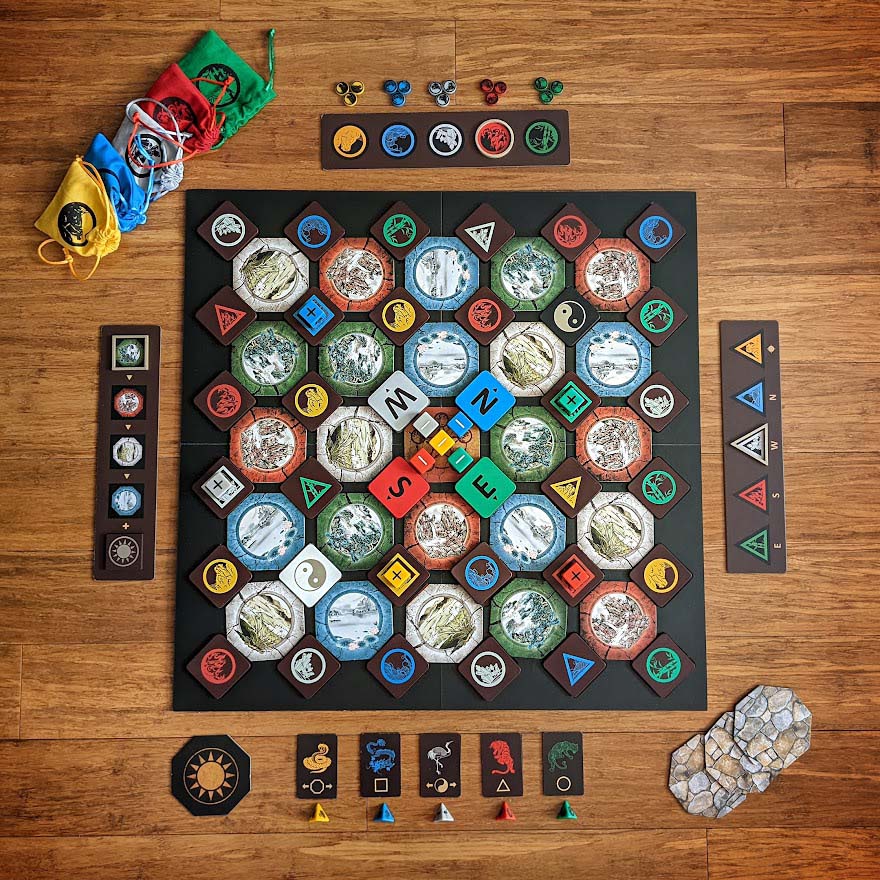
Reducing First Edition’s 180 pieces of chi to twenty began as a production decision. Giving them places on the board opened up something more. In Second Edition, each town can hold one chi. Taking it closes that town to new arrivals; returning chi opens it again. When you spend chi on an animal power, you choose which empty towns receive it at the end of the turn.
You might reopen a town near your next teacher, but someone else could reach it first. That token also makes the town available to Leopard’s power. Collecting and spending now change the routes for everyone.
You can only hold four chi. Reaching a teacher might be worth spending now; keeping enough to resist a push could protect your position. When your own element is prevailing, your chi of that type counts double—but another player may change the prevailing element before you use it.
What does each animal bring?
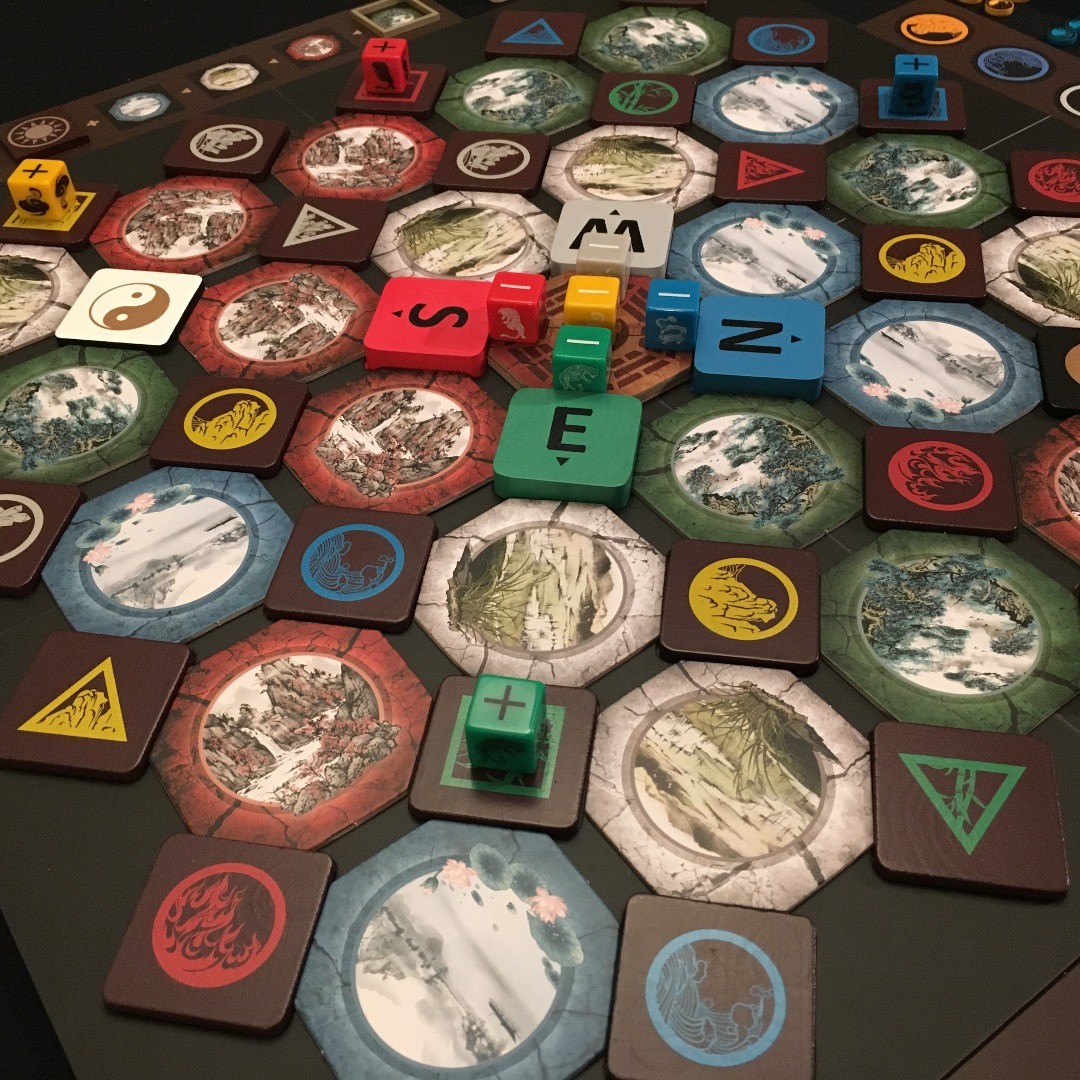
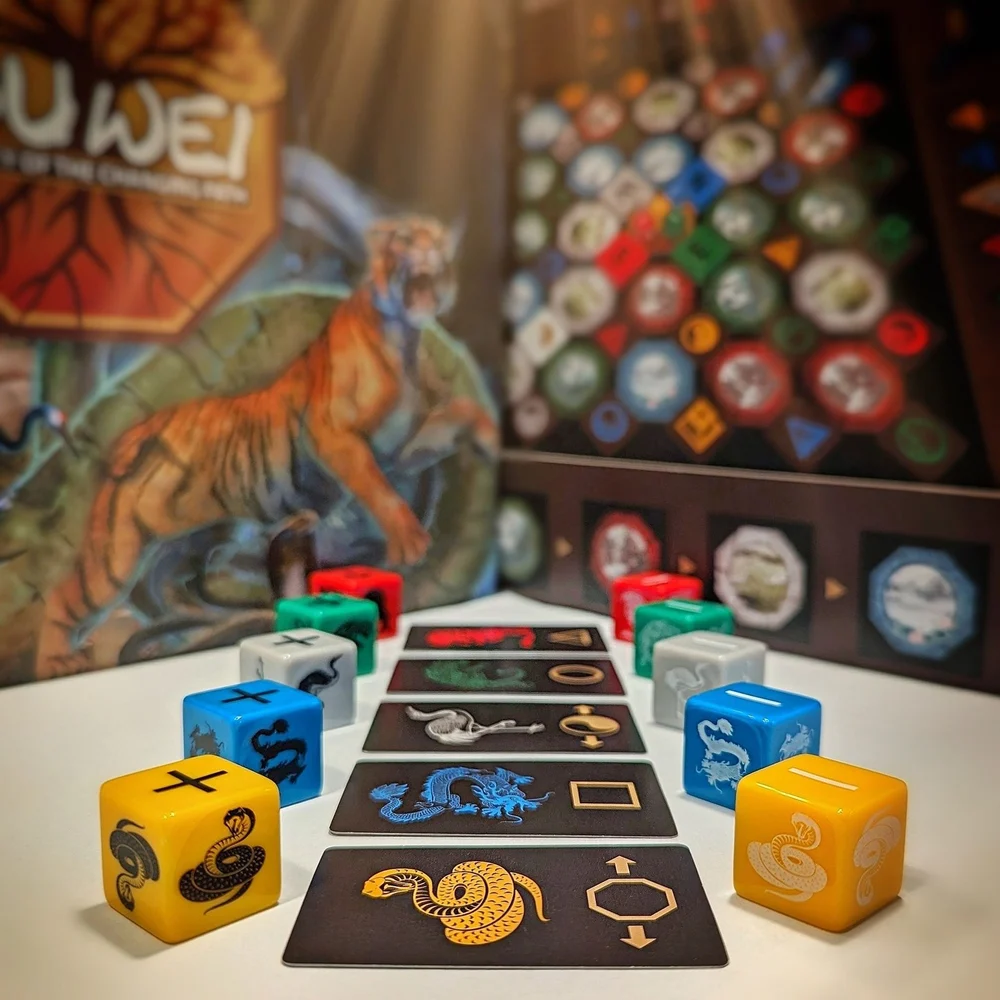
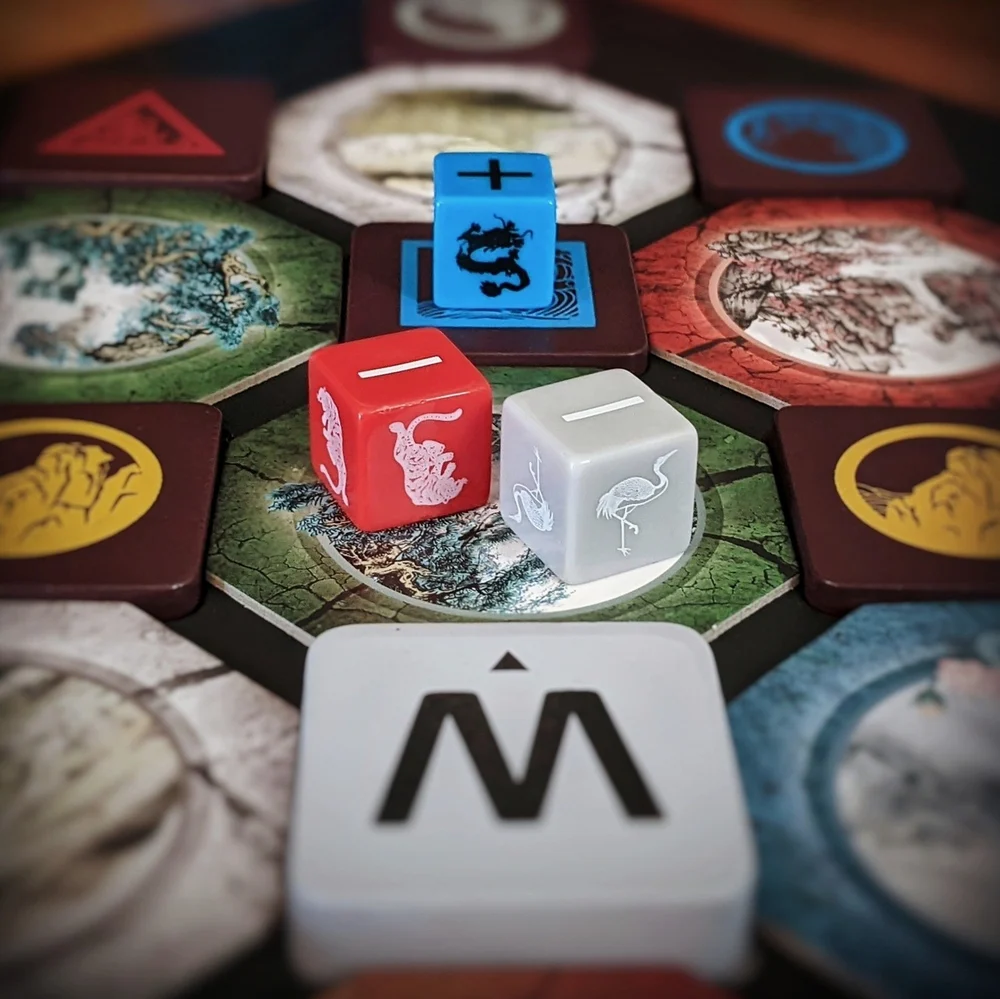
Reducing the maximum reserve to four chi got me thinking about starting each player with their own animal card. That left four more cards to learn, and led me to bring the lineage markers onto the board. Pretty soon, every circle, square, and triangle space had a 3D equivalent sitting on top of it.
Starting with your own animal card introduces the martial artist’s state of mind I’ve wanted players to experience. I like that the asymmetry is subtle: one power suggests a style, then learning the other four expands your possibilities.
The Empire automa made me reconsider those powers. Its pieces churn the terrain between turns, so a power tied to one specific destination could lose its opportunity before you used it.
For Dragon, Tiger, and Leopard, First Edition destinations depended on the element printed on the card. Second Edition gives you a choice:
- Dragon can move to any legal temple.
- Tiger can move to any legal palace.
- Leopard can move to any legal town that still has chi.
Activation costs two prevailing chi instead of three. Each power can still be used only once per game.
Snake could previously move onto an adjacent wall. Its power now reaches one adjacent wall or terrain blocked by the current season, as long as the space is otherwise legal. It can stop or continue moving. Crane can leap to either legal yin-yang tile and continue its movement.
Use a power to reach training sooner, or save it for an escape? That timing is part of the Taoist clockwork of the game. The same starting animal can lead to very different approaches.
How could more players experience the whole game?
Years of feedback showed that most players never went beyond First Edition’s Initiate level. Much of what I wanted them to discover was waiting in Master and Emperor. Bringing those levels together became a central goal.
Pushing and pulling bring advanced interaction into ordinary play. Yielding gives you the initiating player’s spent chi, so accepting a change in position can prepare your next move. Terrain affinities also give you a reason to consider where you stand.
Reducing the chi supply also required simplifying Alchemy and lowering the costs of special actions. Any two chi can now supply one prevailing chi value through Alchemy. With so little to hold, the choice between spending and keeping a reserve becomes harder to ignore.
It greatly amplified the importance of Gatherings as a catch-up mechanic and redistribution network, as well as the thematic idea of sharing special lessons with each other. The chi you offer goes to other participants. Tightening that distribution has led to a game that feels balanced on the edge of a knife, while still in the hands of the players.
Who does the balance move?
In First Edition’s higher levels, the yin-yang balance determines which animal pieces are free to move. In Second Edition, that balance only affects the Empire. Animal players no longer wait for the right balance to move their active pieces, but can use it to influence the Emperor and Empress. The Empire automa keeps both involved across player counts without someone taking their role.
Animal pieces can cross yin-yang tiles, but can no longer end their turn there. Those spaces keep you moving.
Training still gives you a direction: begin with your own style and learn the other four. When your student becomes a student-master, your original master becomes active. You can divide movement between the two pieces; the original master must retrieve its lineage from its palace before both complete the return to the center.
A block matters when it interrupts someone’s progress. A saved power or another open route might let them carry on. I want players to read each other’s possibilities while keeping sight of their own journey.
What can the online game reveal?
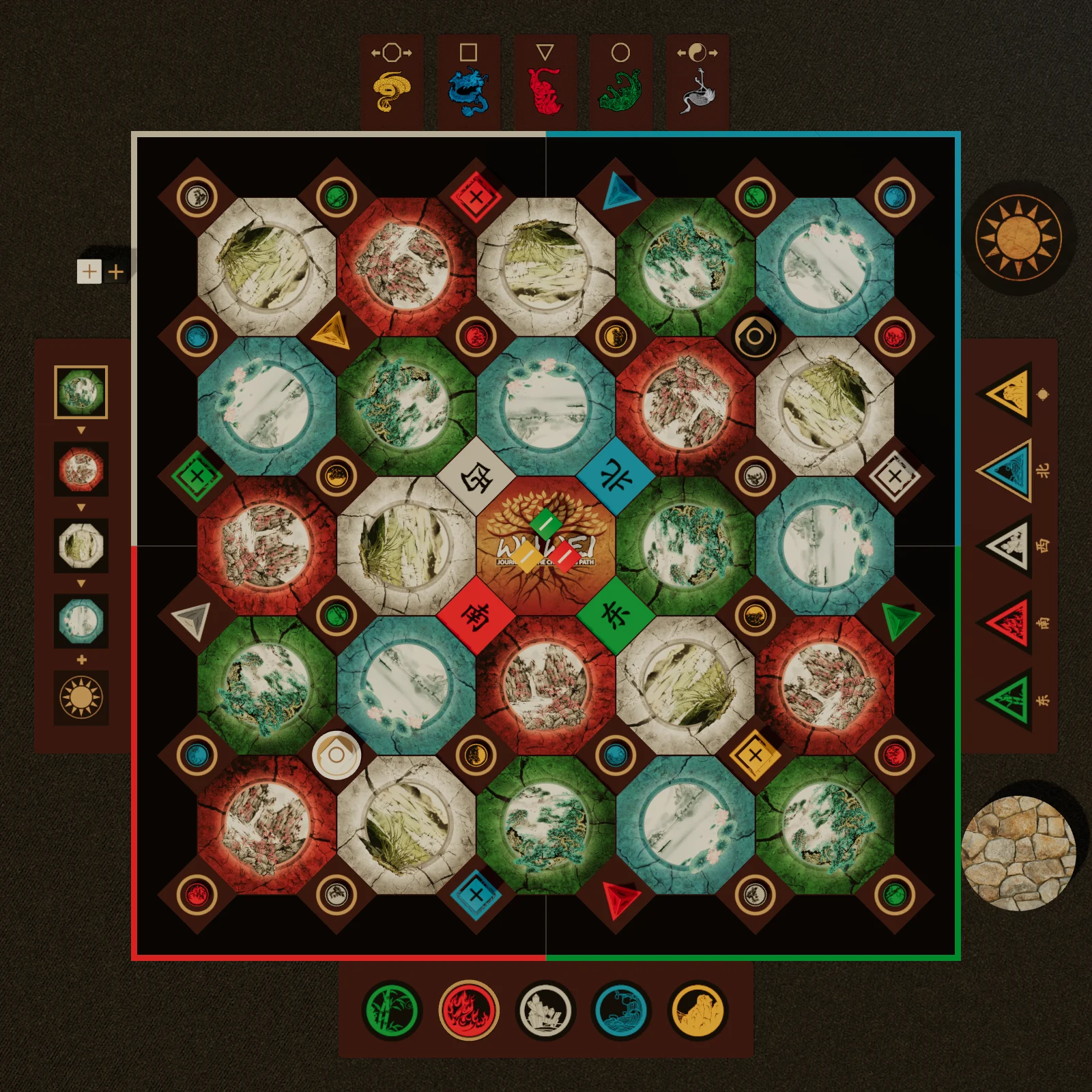
Developing varied bot personalities has made me get specific: when should they train, spend chi, interfere, or use an animal power? Exploring those decisions has helped me describe Second Edition’s strategies and shape the strategy guide.
I designed the animal powers around their purpose in kung fu, each representing skills a martial artist needs. The bot personalities have grown out of those lessons. Your starting animal offers possibilities; your choices develop into a style of play.
The Strategy Guide puts those decisions beside examples from the board: spending chi for a useful landing, comparing an animal power with an ordinary route, and planning an exit as well as the training. Writing those lessons helps me see where the choices connect.
What happens when a piece turns over?
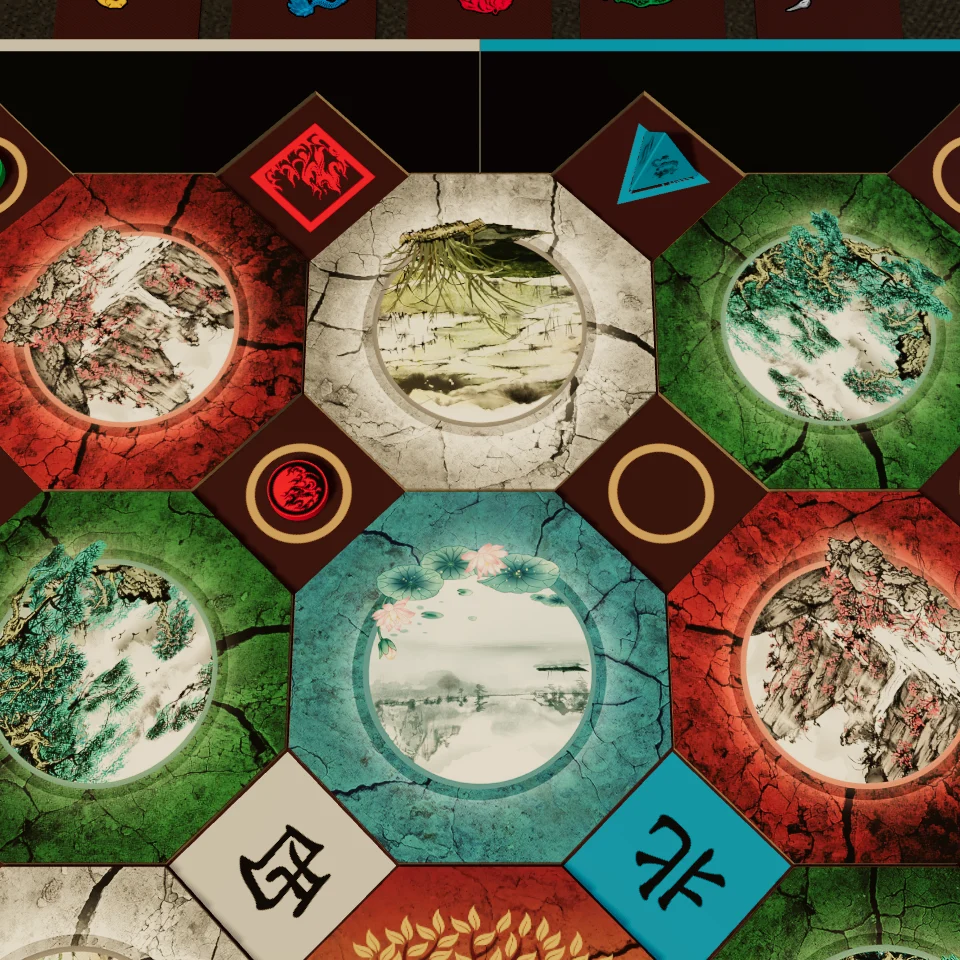
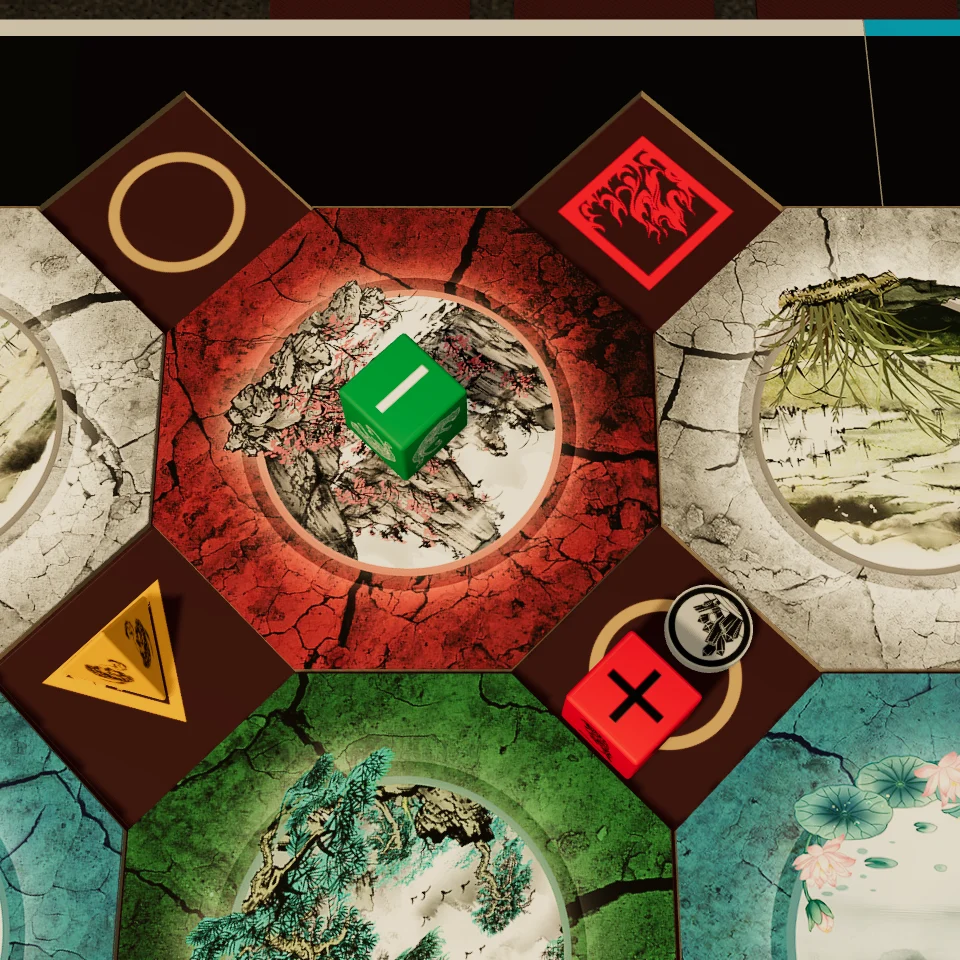
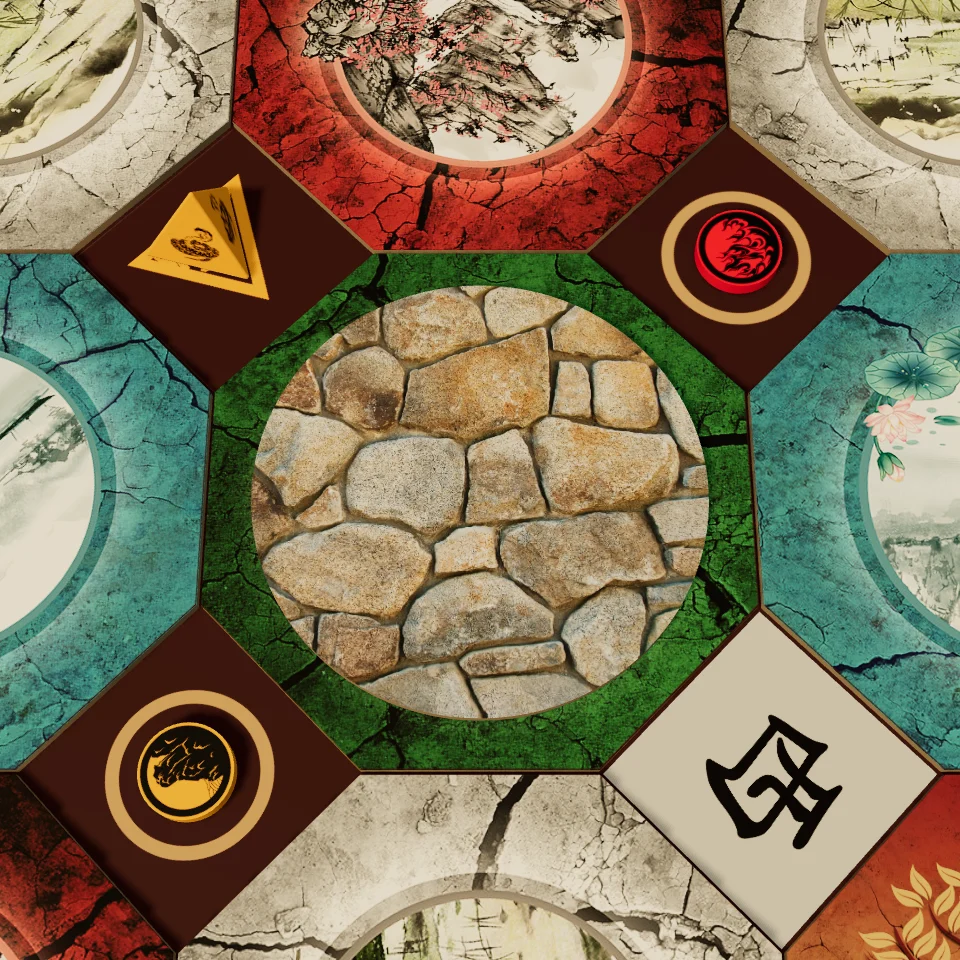
The physical design is changing alongside the rules. Every octagon now has terrain on both sides, and every wall has a field on its reverse. I like that a barrier and an opening can be two faces of the same piece.
The yin-yang tiles are becoming cardboard discs, with larger discs for walls and fields. Nothing holds a wall in alignment with the octagon underneath. A circular disc leaves enough of that octagon visible to show its season, even when the disc turns.
 Wall face
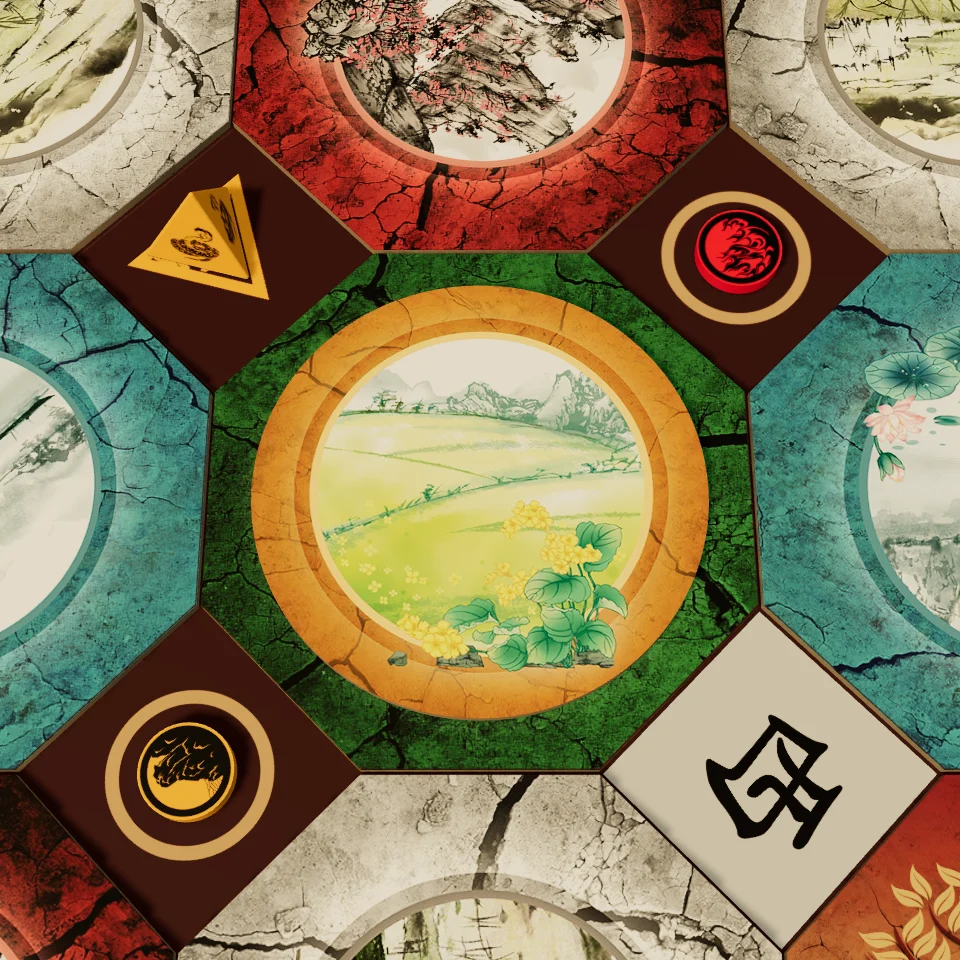 Field face
What form does the board need?
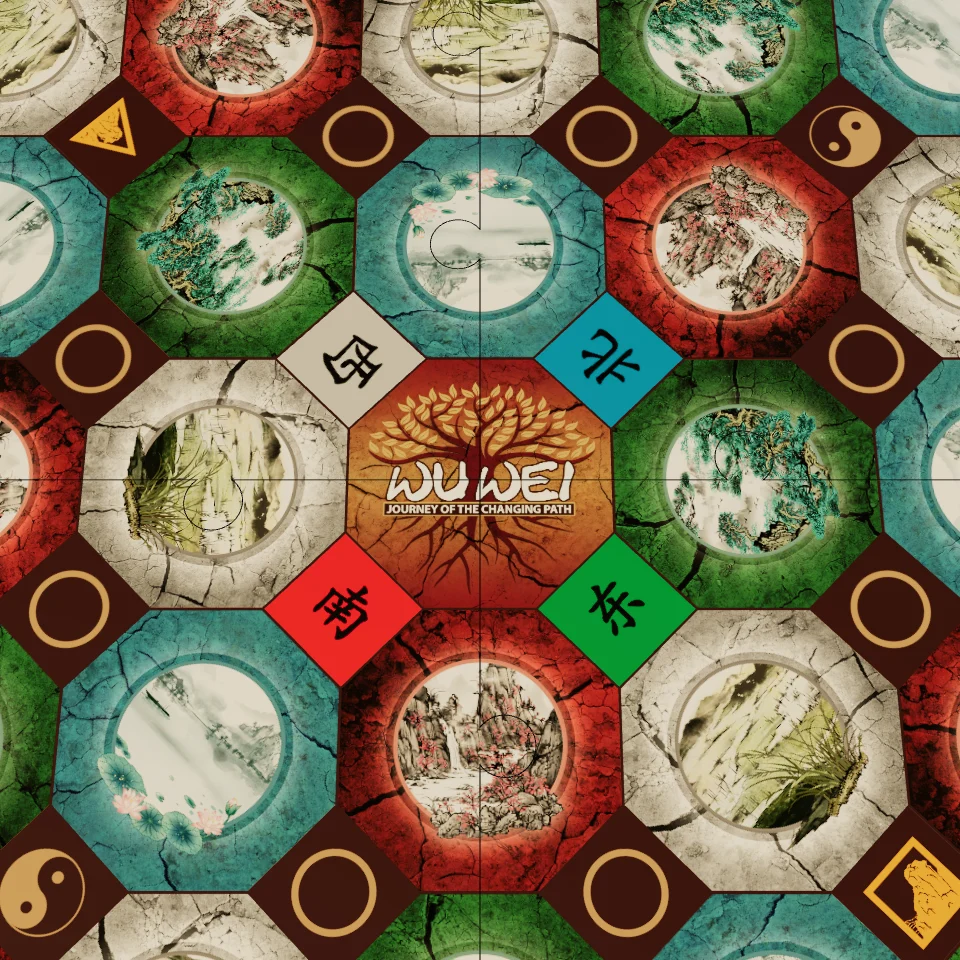
The proposed board replaces the four-fold, double-layered construction with a double-layered puzzle board held together by a frame. It removes the need for the wooden components and provides spaces for the chi.
Modeling it in 3D in the app helped me see how the arrangement could work and explore its proportions.
To fit the smaller square spaces, the cubes need to shrink from 20 mm to 16 mm. I’m considering whether faces would work better than full bodies at that size.
The board has led me back to the pieces, and the pieces to the artwork. I’m still working through those choices.
What am I still unlearning?
My understanding of the Tao, and of myself, has deepened over the years. There’s a process of unlearning in Taoism that feels like a resurrection of potential. I defined these rules; with more perspective, I’ve been able to redefine them.
One hard thing to release was a strategy gem from First Edition’s higher levels: both pieces moving from the beginning, with the yin-yang balance affecting the masters. I still value what that offered. Bringing the experience closer to what worked in Initiate has felt more natural for players.
This time, the edges feel almost as if they’re missing. Fewer exceptions make the game easier to enter without losing its complexity.